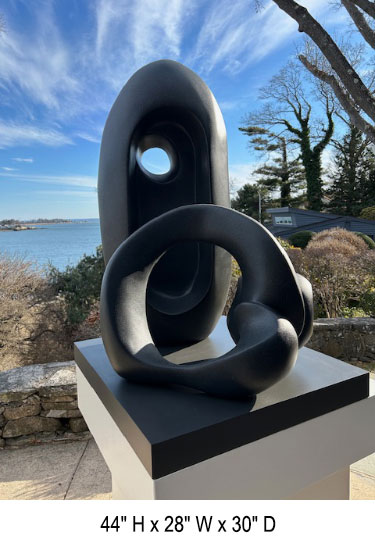
The case for fine art sculpture crafted out of hard-coated foam.
While fine art sculpture is universally recognized as one of the classic art forms, the market for it is extremely limited compared with paintings. This is due to a number of factors. Chief among them, in my view, is the lack of social imperative relative to home display. Specifically, most people want, or feel they should have, attractive paintings on their walls and attractive furniture in their rooms, but few recognize the aesthetic contribution well-chosen sculpture can make, likely because they hardly ever see sculpture in the homes of their friends or in the design magazines they read. For most people, sculpture seems reserved for museums and public places.
There is also the problem that sculpture often costs a lot more than quality painting because it is much more expensive to produce. The need for specialized display places like showcase niches or free-standing pedestals that would displace furniture, combined with the heavy weight of pieces cast in metal or carved from stone, are also perceived deterrents. Paradoxically, unless a sculpture has “heft,” it is often thought of as not being as compelling as the “real thing,” notwithstanding the appeal of its shape, finish and attractive pricing compared with metal and stone!
In September, 2023, I had a one-person show at Graham-Shay 1857, a New York dealer renowned for fine art sculpture. Eight painted hard-coated foam sculptures and two bronzes from my Deconstructing the Oval series were displayed. Prior to this exhibition, the foam sculptures, would have been displayed only as surrogates for bronze casting. This was the first time my foam sculptures were offered for sale as individual works of art in a gallery setting.
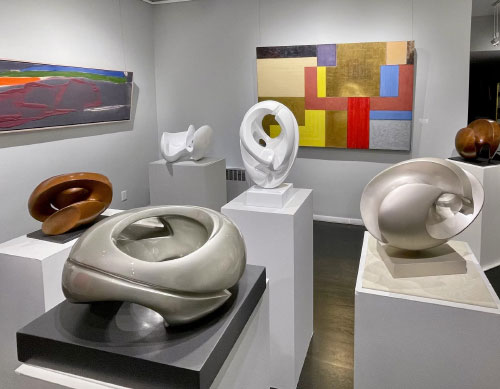 Although the installation was beautiful, and the sculptures seemed to be both well received and complementary to the paintings on the surrounding walls, only a bronze, priced at two to three times the foam sculptures, was sold. As the gallery’s owner, Cameron Shay, later observed, “it takes time to get enough air under your wings to fly,” suggesting that with patience and effective promotion, well-crafted sculpture carved from foam should ultimately come to be appreciated for its exceptional value.
With this in mind, I was most intrigued by what I learned at a recent meeting with Johnson Atelier Digital in Hamilton, NJ, where I had taken a foam maquette I had recently carved but purposely left in its raw, unfinished state so I could ascertain whether producing a finished sculpture through Johnson Atelier Digital would be a cost-justifiable way for me to work in the future, especially for large pieces.
Up to now, all my carvings in foam and stone have been informed by small models which I then scale up to the size I want, roughing out with a variety of reciprocating saw blades, electric drill bits and Sureform® files, and finishing with traditional sculptor tools and abrasives. While I still occasionally work in stone, the bulk of my studio time is spent carving foam.
After I’m satisfied with the shapes I’ve produced, and the way they interact with light, the really hard work begins in the coating, fairing and finishing to ensure my casting foundry has a flawless sculpture from which to mold. Fortunately, I have my husband to help out. The time needed for bouts of sanding epoxy resin and fairing with Bondo® alone can consume between 40 – 60 hours for pedestal-size pieces, and well over 100 for larger sculptures for exterior installations.